
Marinduque Mangrove Research by MMPH Members Earns International Publication

Written by Charles Joseph O. Nicolas, Science Communication Officer

Metro Manila – The undergraduate thesis of Mangrove Matters PH (MMPH) members Charles Joseph O. Nicolas and Bernard John Prodenciado, together with their thesis adviser and Science Communication Lead Genea Nichole Cortez and their mentors in University of Santo Tomas, has been published in Wetlands Ecology and Management, a Quartile 2 journal under Springer Nature.
The paper, titled “Science for wetland conservation: diversity, vegetation structure, and health assessments of mangrove forests in eastern Marinduque, Philippines,” presents one of the most recent field-based assessments of mangroves in Torrijos, Marinduque, an island where updated baseline ecological data of mangroves has been limited.
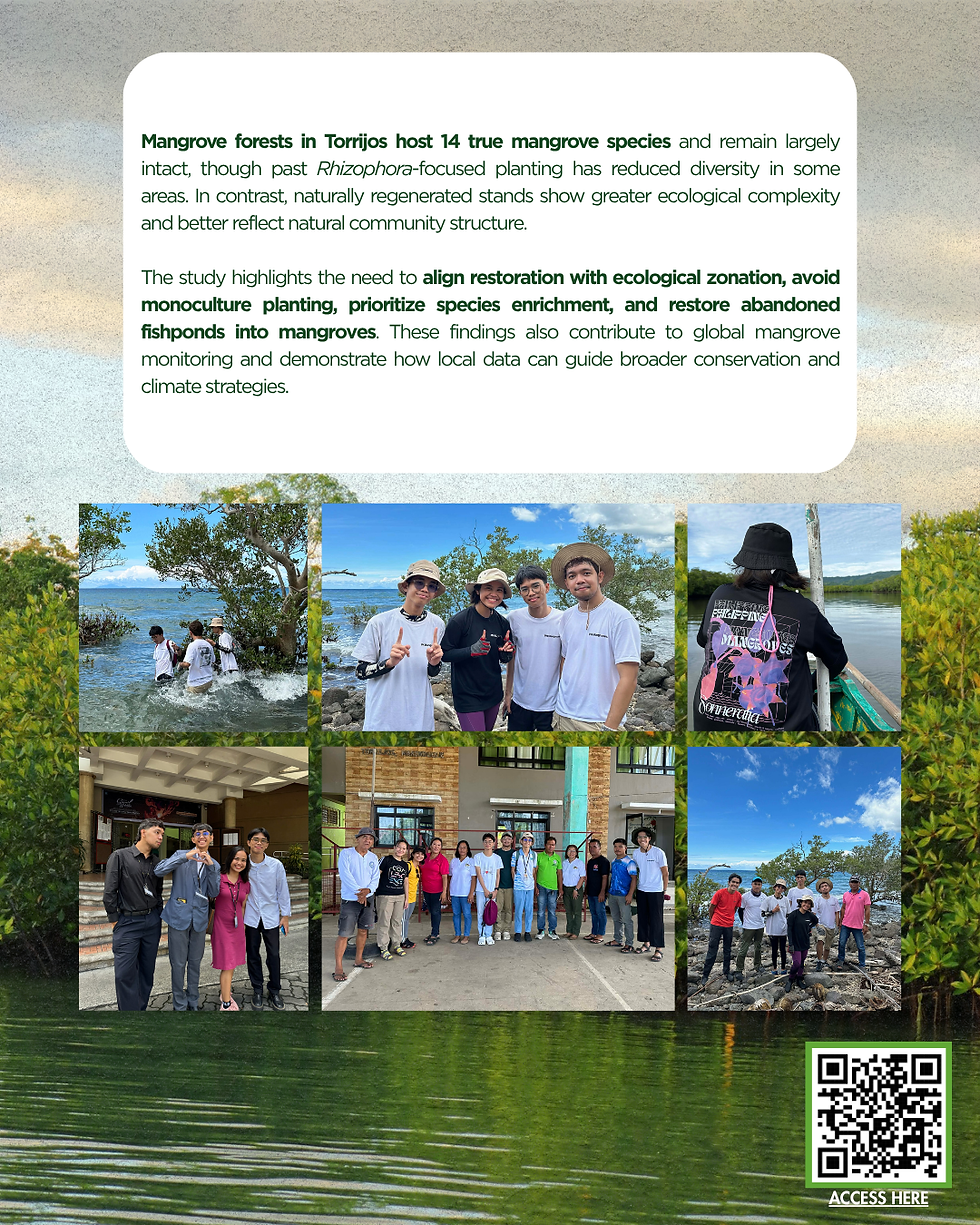
Fieldwork in mangrove sites of Torrijos, Marinduque
The study recorded 14 true mangrove species across different habitat types, forming four distinct vegetation, namely Riverine, Basin, Fringe, and Basin-Fringe shaped by environmental conditions and past restoration efforts. While the site shows overall pristine health, researchers have observed that areas dominated by Rhizophora species tend to form monotypic stands, reflecting the long-standing practice of single-species planting.
These findings point to a recurring issue in mangrove rehabilitation: planting without regard to natural zonation. The study supports restoration approaches that follow science-based approach and correct mangrove zonation planting that favors natural regeneration, protecting of old-growth stands, and restoring abandoned fishponds where mangroves can recover more effectively.
Local study, global relevance
Although focused on a single municipality, the study contributes baseline data that can be used in both regional and global conservation efforts. Its publication in an international journal like Wetlands Ecology and Management further shows that even research conducted in a local island, like the heart-shaped Marinduque, can meet global scientific standards and contribute meaningfully to conservation of mangrove ecosystems.
Mangroves play a critical role in coastal protection and carbon storage, and detailed local assessments like this help bridge the gap between field observations and larger monitoring systems of mangrove ecosystems.
From Undergraduate Research to Publication
What began as an undergraduate thesis has now become part of the scientific literature, demonstrating the potential of student-led research with the support of their mentors, to contribute to advancing conservation methods. The publication reflects both academic work and field experience, shaped by collaboration with local communities who continue to manage and protect these ecosystems.
This publication was made possible through the people of Torrijos, whose deep understanding of local mangroves and continued conservation efforts played a vital role in shaping this study. Rooted in both science and community experience, the study reflects a shared principle: that knowledge should not remain confined, but be returned to and shared with the communities who actively protect these ecosystems.
As pressures on mangroves continue, from reclamation to climate impacts, studies grounded in baseline diversity remains essential. This publication adds to a growing body of work calling for more site-specific, science-based approaches to mangrove conservation in the Philippines and globally.


Comments